Paper: Toward Regulation-Friendly Bearing Fault Diagnosis via Structural Embedding Preserving Machine Unlearning
Authors: Jiyoung Lee (Chung-Ang University, undergraduate), Chaewon Yoon (Chung-Ang University, undergraduate), Hoki Kim (Chung-Ang University)
Venue: Advanced Engineering Informatics (SCIE top ~5%)
URL: https://www.sciencedirect.com/science/article/pii/S1474034626008918
A machine unlearning paper by Chung-Ang University undergraduates has been published in a top SCIE journal.
The paper “Toward Regulation-Friendly Bearing Fault Diagnosis via Structural Embedding Preserving Machine Unlearning,” with Jiyoung Lee of the Department of Industrial Security as first author and Chaewon Yoon as co-author, has been published in Advanced Engineering Informatics, a journal in the top ~5% of SCIE. Both students carried out the work as undergraduate researchers, advised by Prof. Hoki Kim.
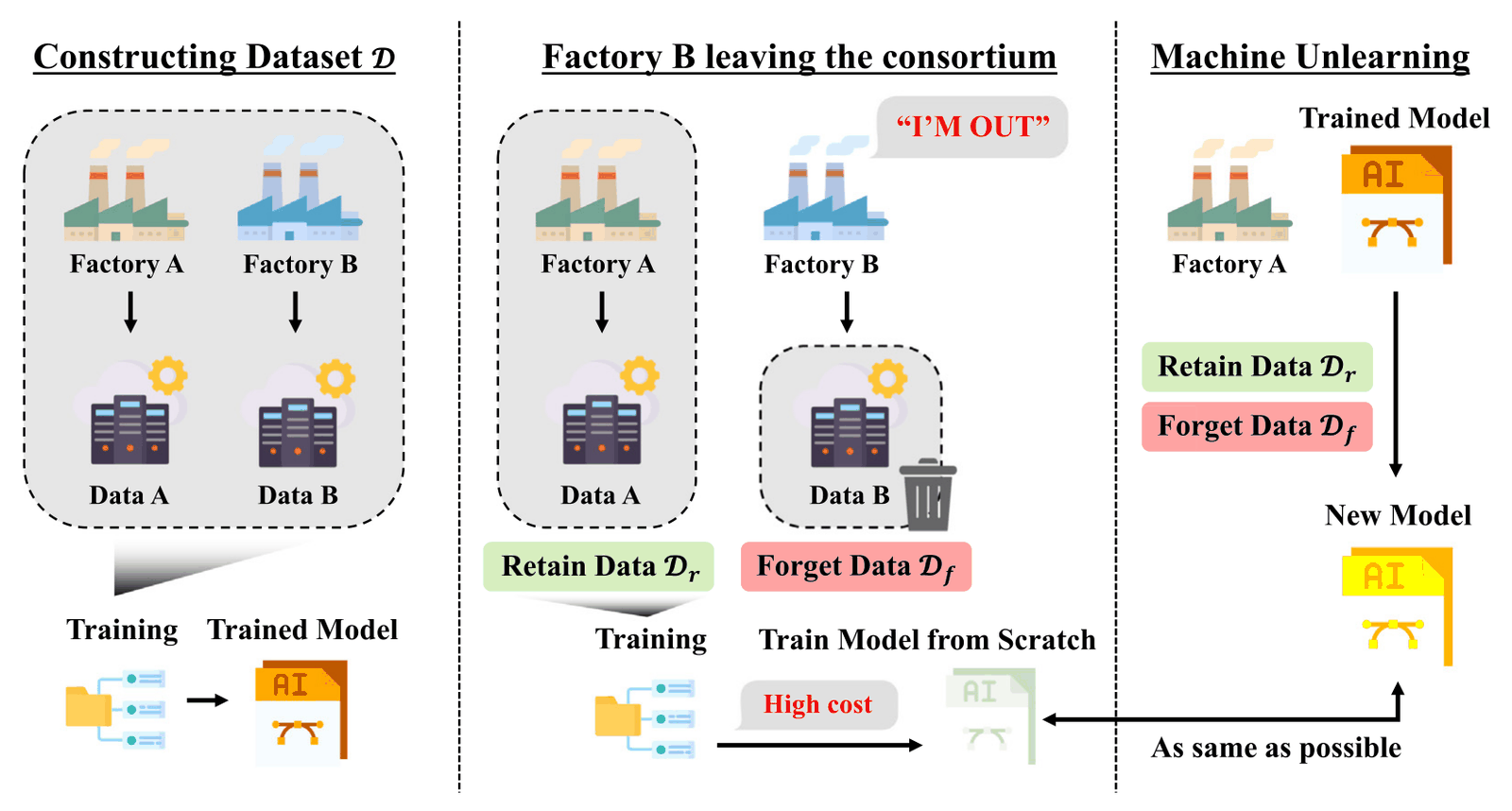
Bearing fault diagnosis models support predictive maintenance by catching equipment failures early. In practice, however, some of the training data may need to be removed because of privacy regulations, contractual obligations, or data quality issues. Machine unlearning removes the influence of specific data without retraining the model from scratch.
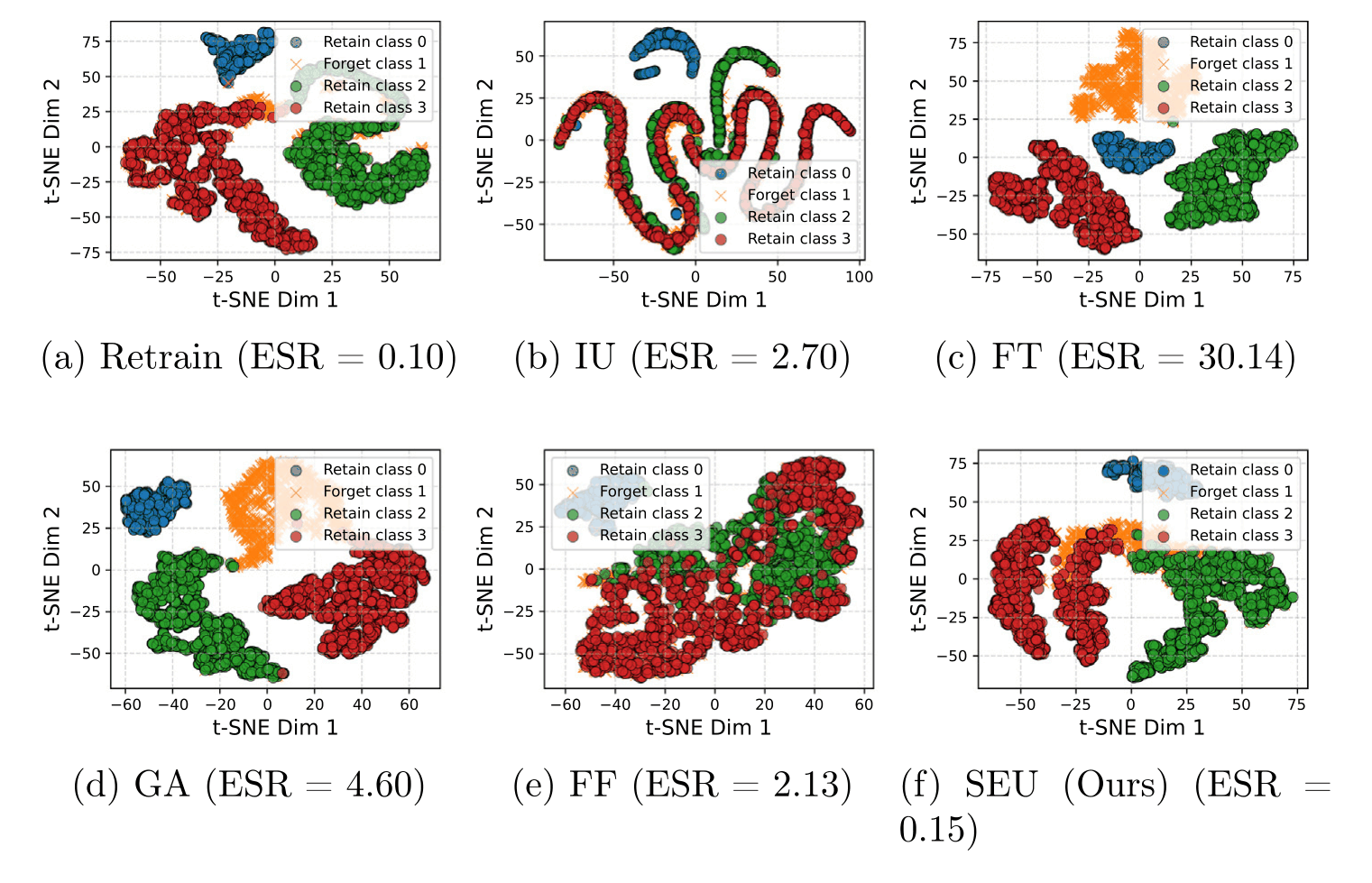
The research team first applied existing unlearning methods systematically to fault diagnosis systems and found that they perform poorly on the time-series vibration data typical of bearing faults. To address this, the team proposed a new method, Soft-directed Embedding Unlearning (SEU), which works directly in the embedding space: it pushes forget samples away from their original class clusters while preserving the structure of retain samples using soft examples near decision boundaries.
Measured with a manifold similarity score, SEU stably approximated the ideal manifold structure, and on both public and private industrial data it achieved more effective unlearning than the compared methods.
The work follows the same team’s earlier paper, Adversarial Retain-Free Unlearning, published in IEEE Transactions on Industrial Informatics.