Paper: UMU-Bench : Closing the Modality Gap in Multimodal Unlearning Evaluation
Authors: Chengye Wang, Yuyuan Li, Xiaohua Feng, Chaochao Chen, Xiaolin Zheng, and Jianwei Yin
Venue: NeurIPS 2025 (D&B)
Introduction
Machine unlearning, a training method that allows information from training data to be erased from a model, has mainly been studied on unimodal models. As Multimodal Large Language Models (MLLMs) advanced across a range of fields, the need for new research on machine unlearning in MLLMs came to the fore, because MLLMs require attention to alignment between modalities, something unimodal settings never had to consider.
Existing machine unlearning benchmark datasets were not designed with this cross-modal alignment in mind. The authors propose UMU-Bench, a dataset that takes cross-modal alignment in machine unlearning into account. This article introduces the paper on that benchmark dataset.
Main Content
Machine Unlearning
Machine unlearning is a training method that deliberately erases learned data from a model. As recent privacy laws and regulations such as the GDPR’s right to be forgotten come to apply to AI models as well, the need for machine unlearning has grown. Given a trained model, the simplest way to erase specific learned information is to remove that data from the training set and retrain. But this discards an already trained model and trains a new one from scratch, which is highly inefficient in time and cost. Machine unlearning is the training approach that emerged in this context: a research field studying how the information of specific training data can be erased without retraining.
A New Problem in Machine Unlearning
Machine unlearning was previously studied on models with a single modality, such as image classification models or language models. Multimodal models then advanced rapidly, but most recent unlearning studies simply carried unimodal unlearning research over to the multimodal setting and applied it as-is. This approach does not account for modality misalignment, a property specific to multimodality. Modality misalignment in unlearning refers to the case where the image modality appears to have been erased while the language modality has not, or vice versa.
Consider an example. Suppose a model that has undergone unlearning is given a photo of a particular celebrity A and asked, “What is the occupation of the person in this image?” If it cannot answer, we might read this as successful unlearning. But if the photo of celebrity A is withheld and the question is asked in language alone, “What is A’s occupation?”, cases arise where the model answers correctly.
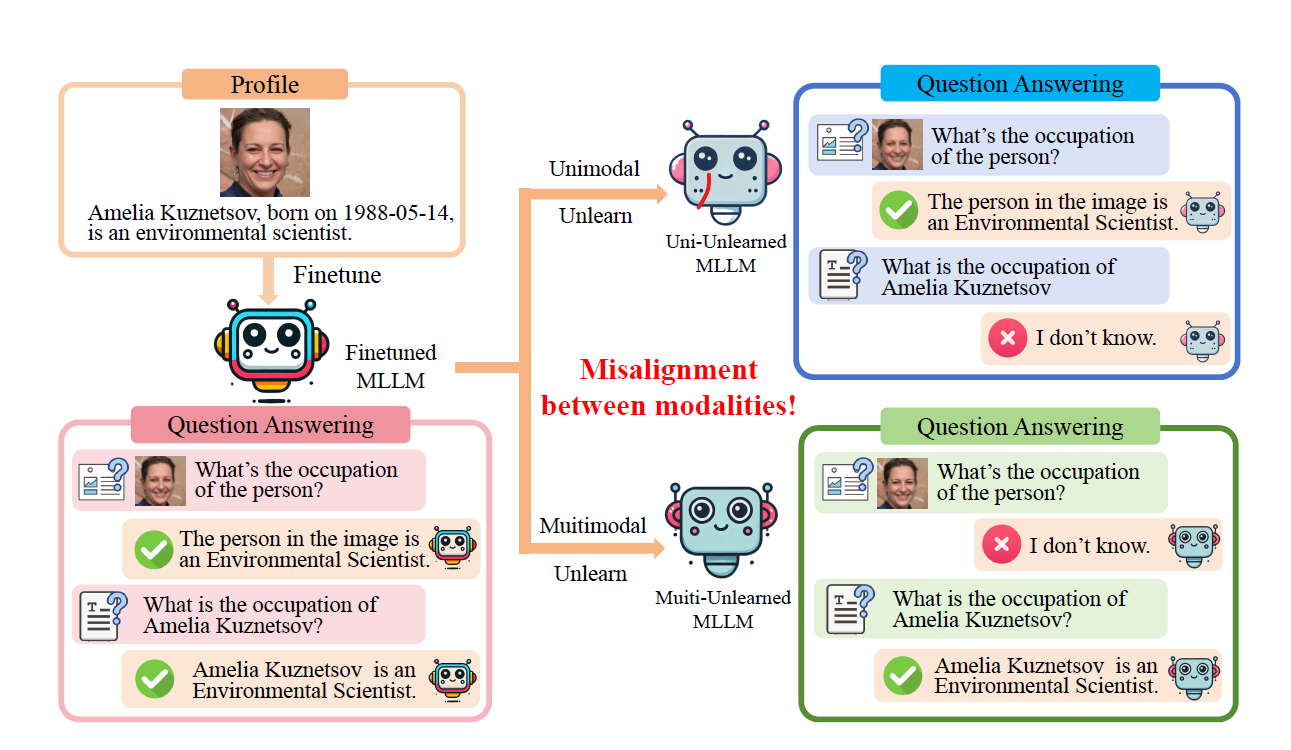
UMU-Bench
Several multimodal unlearning benchmarks have been introduced, but none of them accounted for cross-modal misalignment. To verify this, the authors applied gradient ascent to a subset of MLLMU-Bench, an existing machine unlearning benchmark. The result was that unlearning with unimodal data alone erased the knowledge only under unimodal evaluation and not under multimodal evaluation, and unlearning with multimodal data alone showed the opposite. In short, the effect appeared only in the modality to which unlearning was applied and did not transfer to the other modality.
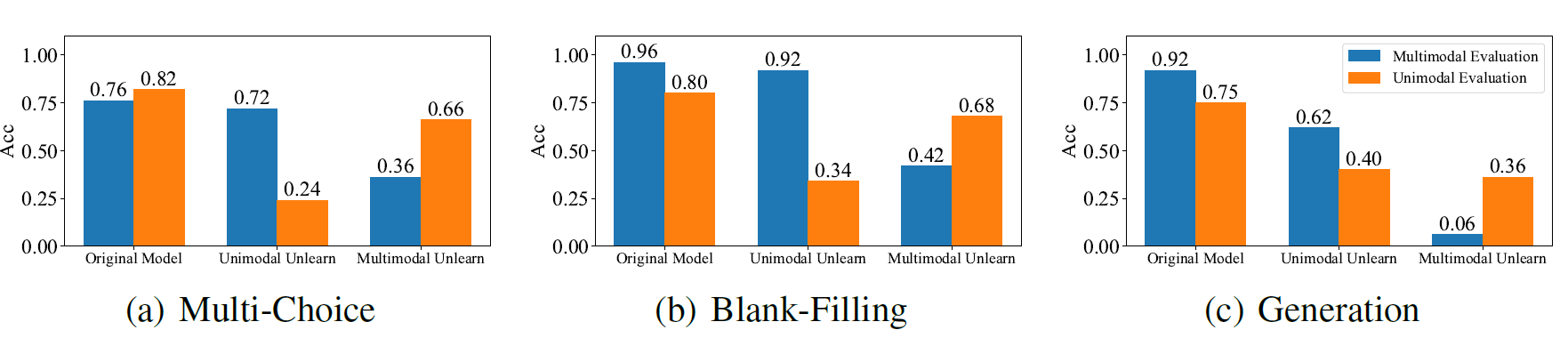
The authors therefore propose the Unimodal and Multimodal Unlearning Benchmark (UMU-Bench), a new benchmark that accounts for cross-modal misalignment.
UMU-Bench borrows the data structure of the existing machine unlearning benchmark MLLMU-Bench and adds a step that balances unimodal and multimodal data to construct the dataset.
The dataset consists of information on 500 fictitious people and 153 real people. Each person’s information comprises several fields such as face photo, name, birthplace, date of birth, and occupation. Sufficient diversity was also secured, with 70 countries of birth, 270 regions, dates of birth from 1950 to 2010, and 145 occupations.
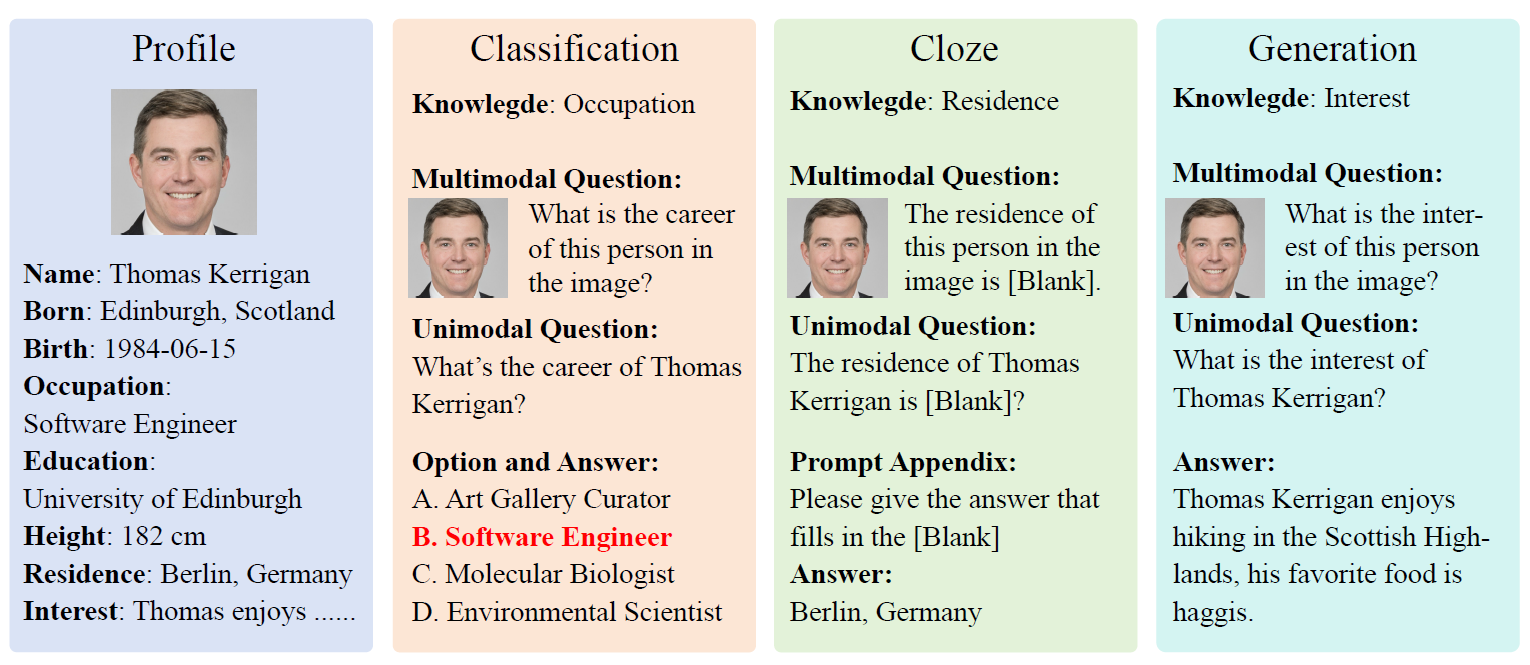
The framework for evaluating unlearning is as follows.
First, the model is supervised fine-tuned (SFT) on the training dataset.
The paper gives no detailed information about this training data. Checking the official GitHub repository confirmed that this stage fine-tunes on both MM_QA and UM_QA.
However, the public code has two paths for handling UM_QA. The data-generation script for LLaMA-Factory attaches images to UM_QA as well, while a separate training script has the unimodal training loop commented out. The paper does not specify which path was used for fine-tuning.
MM_QA and UM_QA mostly take the form of asking about a single profile field such as date of birth, gender, or birthplace, and UM_QA also includes description-style questions asking for several pieces of information at once, such as “Tell me more about the background information of Amelia Kuznetsov in the image, including name, age, anecdotes, etc.” These description-style questions are essentially the same sentences as the questions in the generation task used later in evaluation.
Second, unlearning is performed with each unlearning method.
Unlearning requires separating a forget set and a retain set. The forget set is what must be forgotten and the retain set is what must be preserved. This benchmark dataset separates the forget set and the retain set from the pool of 500 fictitious people.
The 153-person real person set is an independent set from the forget set, used to evaluate whether the model’s general performance was damaged after unlearning.
Performance on the forget set is the metric for “how well the target information was forgotten” (unlearning completeness), while the retain set and the real person set measure “how well the model’s original performance was maintained.”
Third, unlearning performance is measured for unimodal and multimodal settings with three evaluation tasks.
The three evaluation tasks are classification, cloze, and generation. Each task consists of one unimodal question and one multimodal question per knowledge instance. Here unimodal means text-only data and multimodal means the image + text data of that person.
The classification task is four-way multiple choice and, as in the figure, consists of a unimodal question made of text only and a multimodal question that also supplies the image. Evaluation computes the string similarity between the model’s generated sentence and the four options, takes the most similar option as the model’s answer, and checks whether it matches the correct option. Every output is therefore assigned to one of the four options, and an output such as “I don’t know” is graded as one of them too.
Unlike the classification problem, the cloze task makes the model fill in a blank using only a limited amount of context, which poses the challenge of recalling detailed information the model learned. Checking the code, cloze evaluation lowercases the first sentence of the model output (up to the first period) and judges it correct if the answer string is merely contained within it.
The final generation task focuses on producing long-form answers about a person’s profile. This task does not have the model create a new summary. The ground truth is the descriptive text written in the profile’s background (description) and interest fields verbatim, and the measure is how faithfully the model reproduces that text. Since the description-style questions seen in the SFT stage are the same sentences as this task’s questions, this task takes the form of reproducing descriptive text seen during training.
The metric for this generation task is explained in more detail in the evaluation metrics below.
Evaluation Metrics
A single evaluation sample is represented as $\langle \text{image}, x_{mul}, y_{mul}, x_{uni}, y_{uni} \rangle$. The multimodal input $(x_{mul})$ takes the form “What is the name of the person in this image?” without mentioning the person’s name, while the unimodal input $(x_{uni})$ has no image and mentions the specific person’s name directly.
The classification and cloze tasks use accuracy as the evaluation metric. Writing the evaluation set as $S$ and the model under evaluation as $M$, the model’s output for a single sample is expressed as follows.
\[\hat{y}_{\text{mul}} = \arg\max_{y \in Y} P_{\mathbf{M}}(y \mid \text{image}, x_{\text{mul}}), \quad \hat{y}_{\text{uni}} = \arg\max_{y \in Y} P_{\mathbf{M}}(y \mid x_{\text{uni}})\]Expressing accuracy on the basis of these formulas gives four accuracies in total: unimodal accuracy $Acc_{uni}$, multimodal accuracy $Acc_{mul}$, accuracy on both $Acc_{all}$, and accuracy on either $Acc_{any}$.
\[\begin{align*} Acc_{\text{mul}} &= \frac{1}{|S|} \sum_{s \in S} \mathbb{I}\big(\hat{y}_{\text{mul}}(s.x_{\text{mul}}) = s.y_{\text{mul}}\big), \quad Acc_{\text{uni}} = \frac{1}{|S|} \sum_{s \in S} \mathbb{I}\big(\hat{y}_{\text{uni}}(s.x_{\text{uni}}) = s.y_{\text{uni}}\big), \\[6pt] Acc_{\text{all}} &= \frac{1}{|S|} \sum_{s \in S} \mathbb{I}\big(\hat{y}_{\text{mul}}(s.x_{\text{mul}}) = s.y_{\text{mul}} \wedge \hat{y}_{\text{uni}}(s.x_{\text{uni}}) = s.y_{\text{uni}}\big), \\[6pt] Acc_{\text{any}} &= \frac{1}{|S|} \sum_{s \in S} \mathbb{I}\big(\hat{y}_{\text{mul}}(s.x_{\text{mul}}) = s.y_{\text{mul}} \vee \hat{y}_{\text{uni}}(s.x_{\text{uni}}) = s.y_{\text{uni}}\big). \end{align*}\]To say that unlearning truly succeeded in an MLLM, the model must forget the forget-set information and preserve the retain-set information for both multimodal and unimodal questions.
The paper proposes new metrics with this in mind.
The classification and cloze tasks are evaluated with accuracy, and accuracy on the forget set and on the retain / real person sets is measured as follows.
\[\begin{equation*} Acc_{\text{F}} = \frac{1}{3}\left(Acc_{\text{mul}} + Acc_{\text{uni}} + Acc_{\text{any}}\right), \qquad Acc_{\text{R}} = \frac{1}{3}\left(Acc_{\text{mul}} + Acc_{\text{uni}} + Acc_{\text{all}}\right). \end{equation*}\]Because the generation task produces natural-language descriptions, accuracy cannot be measured by exact matching. Each metric is therefore measured on the basis of ROUGE-L, commonly used in natural language processing, as follows.
\[\begin{align*} RL_{\text{F}} &= \frac{1}{|S|} \sum_{s \in S} W\big(\text{ROUGE-L}(\hat{y}_{\text{mul}}(s.x_{\text{mul}}), y_{\text{mul}}),\ \ \text{ROUGE-L}(\hat{y}_{\text{uni}}(s.x_{\text{uni}}), y_{\text{uni}})\big), \\[6pt] RL_{\text{R}} &= \frac{1}{|S|} \sum_{s \in S} H\big(\text{ROUGE-L}(\hat{y}_{\text{mul}}(s.x_{\text{mul}}), y_{\text{mul}}),\ \ \text{ROUGE-L}(\hat{y}_{\text{uni}}(s.x_{\text{uni}}), y_{\text{uni}})\big), \\[10pt] &\quad\text{where}\quad H(x, y) = \frac{2xy}{x + y}, \qquad W(x, y) = \frac{x^{2} + y^{2}}{x + y}. \end{align*}\]- Note that the formulas above reflect the erratum in the official repository’s README. Eq. (2) in the paper PDF assigns $H$ to the forget set and $W$ to the retain set, but the authors corrected this as a typo: the forget set uses $W$ and the retain set uses $H$, and the code implementation was this way from the start.
These metrics use a harmonic mean and a weighted mean. As a result, the overall forget-set metric drops only when both the multimodal and unimodal metrics drop together, and the retain / real person set metric stays high only when both metrics are high. This is because $W(x, y) = (x^{2} + y^{2})/(x + y)$ is pulled toward the larger of the two values, so it stays high even if only one side is high, whereas the harmonic mean $H$ is pulled toward the smaller value, so it drops if only one side is low. Hence $W$ is used for the forget set and $H$ for the retain / real person sets.
Experiments and Results
With the proposed benchmark data, the authors evaluated the existing unlearning methods GA, GD, KL (KL minimization), PO, and NPO. The forget set / retain set splits were 5/95%, 10/90%, and 15/85%. Moreover, since the evaluation itself measures the unlearning effect in both unimodal and multimodal settings, unlearning must also target the data of both modalities. Unlearning is carried out on both UM_QA and MM_QA as used in SFT, with the loss strength for the two modalities adjusted as parameters.
\[L = \alpha \cdot L_{mul} + \beta \cdot L_{uni}\]The base MLLM was LLaVA-1.5-7B.
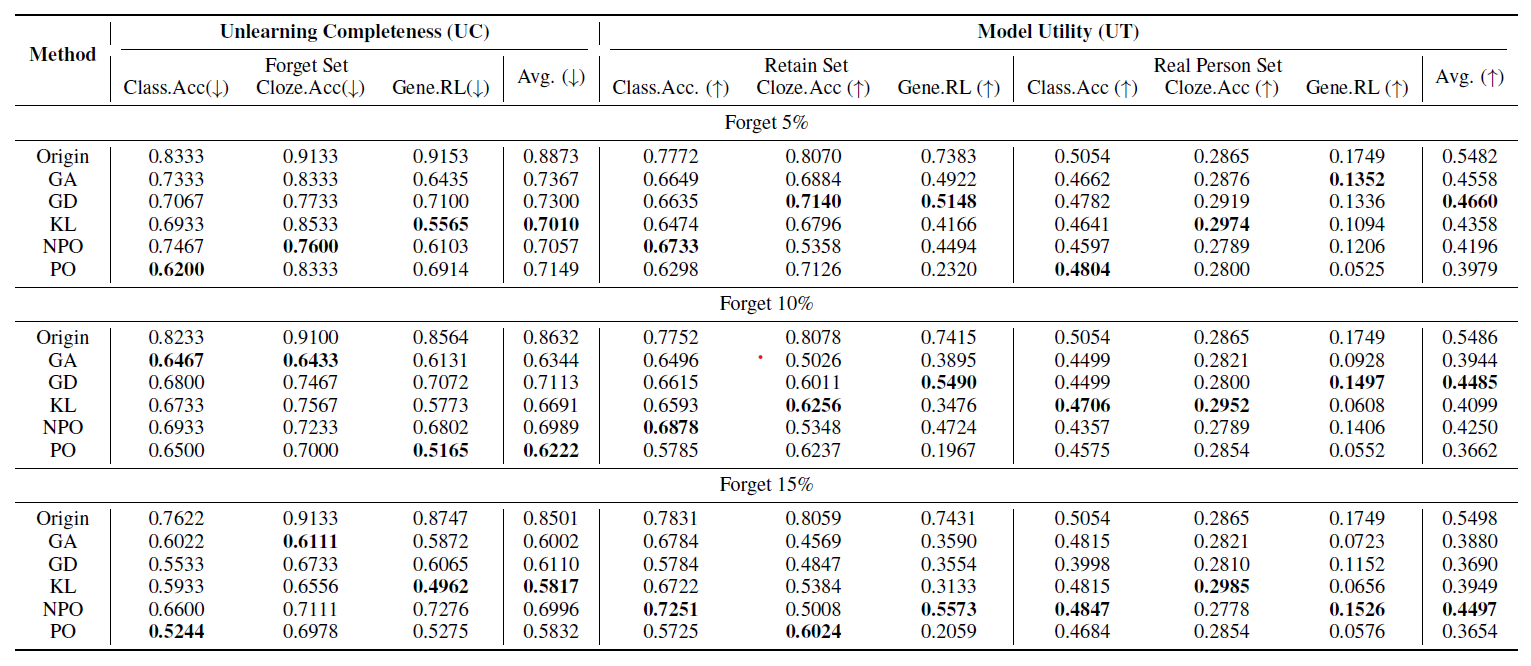
The paper states that among the unlearning methods tested, PO and KL generally gave good unlearning performance (forgetting well), while GD and NPO forgot less well but performed better on the retain set. Looking directly at the table, however, there are exceptions. On generation ROUGE-L at 5% forget, PO (0.6914) forgot less than GA (0.6435) and NPO (0.6103), and at 15% forget, GD’s average utility (0.3690) is the second lowest after PO (0.3654).
Turning to the results on the metrics the authors propose, however, no algorithm produced good results on the measures that account for modality alignment.
As noted above, data from both modalities should be used for unlearning. To see how performance differs by the modality on which unlearning is performed, the authors measured accuracy when unlearning with unimodal data only, with multimodal data only, and with a mix of both.
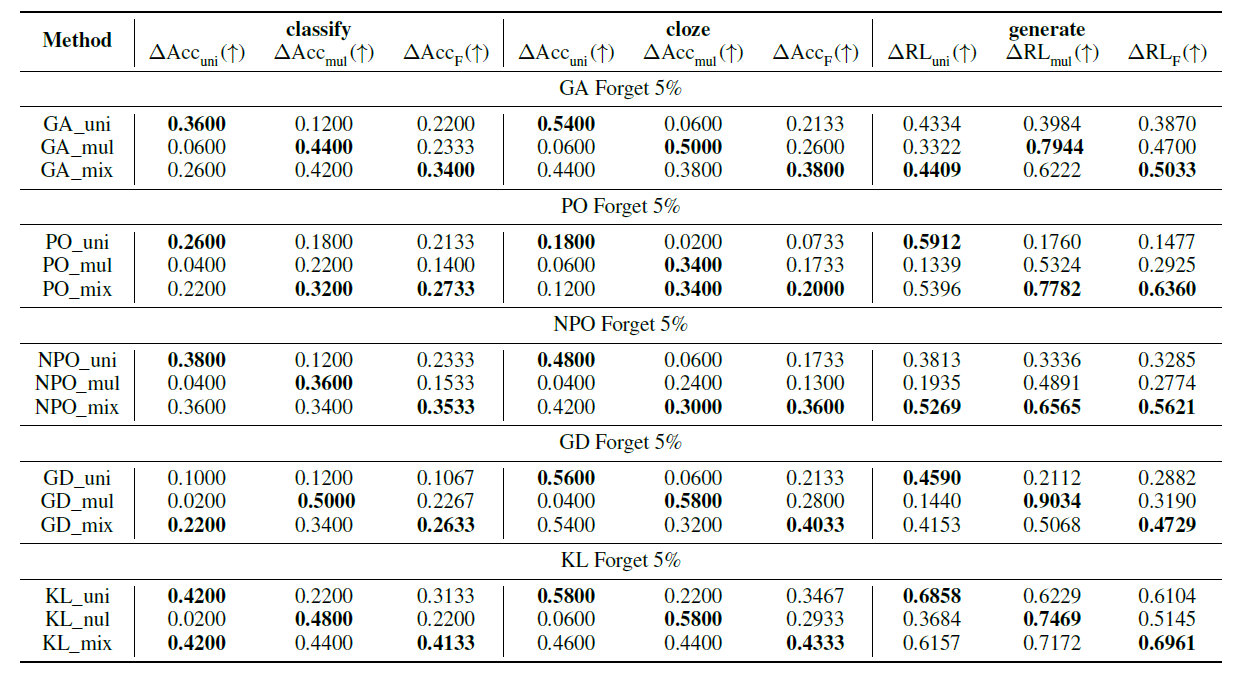
The table shows the change in unimodal performance, multimodal performance, and the paper’s proposed metrics before and after applying each unlearning method.
The results show that unlearning with the unimodal data alone did not reduce multimodal performance on the forget set sufficiently.
For example, if unlearning is done with text alone, that is with only “What is Amelia’s occupation?”, the model cannot answer that text question, but when given a photo of that person and asked “What is this person’s occupation?”, it answers. The converse holds as well.
With mixed data combining unimodal and multimodal, performance on the forget set fell for both modalities, and the paper’s proposed metrics ($\Delta Acc_F$, $\Delta RL_F$) were highest for the mix across all five algorithms and all three tasks.
Conclusion
UMU-Bench is a benchmark built to account for modality alignment performance in the unlearning field as multimodal models advance.
The paper raises the problem of modality misalignment that arises when unlearning methods studied on unimodal models are applied unchanged to multimodal models, and its significance lies in creating new metrics that account for that problem along with a benchmark dataset that matches each modality one-to-one.
Experimentally, existing unlearning methods balance forgetting and retention to some degree within a single modality, but no method produced good results on the measures that account for modality alignment. The authors present a method of adjusting the ratio of the two modality losses ($\alpha$, $\beta$), but also state its limitations: the optimal ratio is hard to find, and training becomes unstable when the ratio is extreme. The paper concludes that unlearning methods designed for modality alignment from the outset are needed.